
Researcher Connect Seminar - Application for Strategic Topics Grant (STG)
Updated: Dec 22, 2025
23 June 2025

Comprehensive Primary Healthcare Collaboratory (CPHC)
Researcher Connect Seminar:
Application for Strategic Topics Grant (STG)
SUMMARY
Speakers:
Prof Christopher Leung, Chairperson and Clinical Professor Department of Ophthalmology, HKUMed
Prof Doris Yu, Professor and Chair in Research, School of Nursing, HKUMed;
Social Healthcare Convenor of CPHC
Sharing by Prof Christopher Leung
Background
Set up to support collaborative research in specific areas which can help Hong Kong overcome imminent challenges and capture emerging opportunities the Strategic Topics Grant (STG) provides a maximum funding of $40 million over five years, with an additional requirement of 10% matching funding from participating universities.
Application Procedures
⎼ Submission of preliminary proposal
⎼ Shortlisted project teams to submit full proposal
⎼ Further shortlisted project teams will be invited for selection interviews
Assessment
The assessment criteria are as follows:
a) the academic merit;
b) the long-term goal of the proposal and its potential to help Hong Kong overcome imminent challenges and capture emerging opportunities under the strategic topics;
c) credentials of the project team;
d) existence of a clear strategy; and
e) sound structure for an excellent research project.
Proposal Elements
Each STG proposal should emphasise three key elements:
1) Mission – Strategic alignment with Hong Kong's imminent needs
2) Impact – Articulation of real-world translation
3) Methods – Multi-institutional & multi-disciplinary collaborative framework
The Project Development Journey
Funded Project
Title: Development and Deployment of a Community-Based Eye Care Model for the Provision of Primary Eye Care Services
To secure the grant, the following aspects were highlighted and elaborated clearly in the proposal:
1) Mission
To introduce primary eyecare services in Hong Kong via developing and deploying a community-based eye care model at community health centres with integration with the Specialist Out-patient Clinics (SOPC) for detecting and treating chronic eye diseases, and aligned with the territory’s primary healthcare blueprint.
2) Methods
Key project stages include:
- Development and deployment of an AI-powered optical coherence tomography (OCT) system;
- Partnership with District Health Centres to build the necessary infrastructure;
- A pragmatic clinical trial comparing the standard of care with the new community-based model across two HA clusters.
Collaborative and Multidisciplinary Approach
- Forming a multidisciplinary team from HKU, CUHK, PolyU, DHCs, and HA—including ophthalmologists, AI experts, primary healthcare professionals, ocular health economists, public health specialists, policy experts, and nursing professionals—to collaborate across multiple domains.
- Industry support for implementing AI in clinical practice
- Clear stakeholder roles and regular research meetings
- Preliminary evidence of capacity to deliver community-based programs
3) Impact
1) Reducing wait times for new patient appointments at the specialist outpatient clinics
2) Improving the diagnostic sensitivity and specificity for detection of chronic eye diseases
3) Mitigating the burden of visual impairment and blindness in Hong Kong
Evaluation and Outcomes
Primary outcome measure
Time to diagnosis of:
- Glaucoma
- Wet age-related macular degeneration (choroidal neovascularization)
- Severe non-proliferative/proliferative diabetic retinopathy
- Diabetic maculopathy (leading causes of irreversible blindness)
Secondary outcome measures
i. Time to diagnosis of cataract, under- or un-corrected refractive errors, and PAC
ii. Wait time of new patient appointments in ophthalmology at SOPCs
iii. Sensitivity and specificity for detection of glaucoma, wet age-related macular degeneration, diabetic retinopathy, undercorrected refractive error, and cataract.
Hypothesis
Under the new model:
- Healthcare professionals would need less time to reach a diagnosis
- Patients will have a shorter wait time for new patient appointments at SOPC compared with the current model of care: emphasise shorting the wait time from up to 204 weeks to within 8 weeks
- Achieve diagnostic sensitivity and specificity that would be higher or at least equivalent to those assigned to the current model of care.
Conclusion
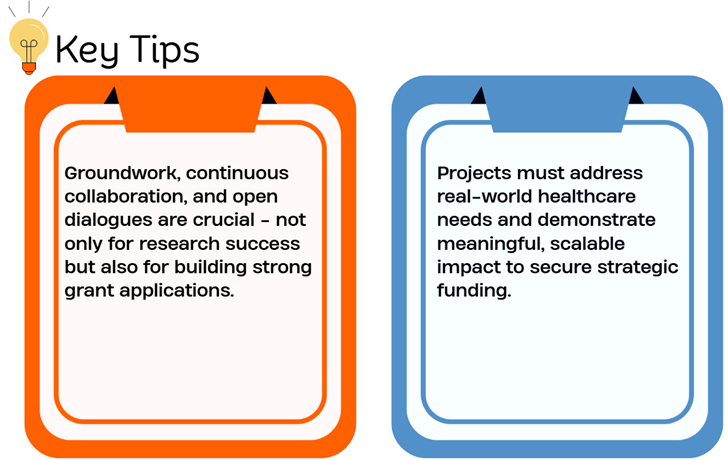
The project represents a strategic, evidence-driven approach to addressing a critical gap in Hong Kong’s healthcare system through technological innovation and interdisciplinary collaboration.

Sharing by Prof Doris Yu
Background
Funded Project
Title: Foundation Models-empowered Ambient Intelligence Systems for Early Diagnosis, Personalized Intervention, and Complex Cross-Disease Interplay Analysis of Aging-Related Degenerative Diseases
Inception of the Research Project
Mission
To significantly enhance the independence and quality of life for older adults living with dementia and sarcopenia through innovative ambient intelligence systems and Foundation Models (FM)
1. Start with a collaborative team with mutual trust
- A track record of prior research collaboration is a pre-requite of STG;
- A cohesive team is imperative to ensure constructive and cooperative effort.
- constructive communication
- active & joint participation
2. Identify a Unified Vision
- “Open dialogues” -- Sustained interdisciplinary discourse within research endeavors facilitates the navigation of shared intellectual priorities.
- Spanning from brain to muscle; from digital biomarkers to EHR data linkage
- “Dream-maker” -- Foster intellectual openness to generate visionary research idea, prioritizing curiosity-driven exploration over feasibility paradigm.
- Using AI to pick up the digital biomarkers and develop an alert system à Connect the alert system to the social workers for proactive intervention.
- “Collaborative architecture” -- forging collaborative research agenda & tailored it to fit with the STG funding priority.
- Using advanced technology to address health care challenges
3. Leveraging preliminary work
- Create a compelling rationale – use individual and collaborative work to support the storyline of the grant proposal.
- Healthy aging & clinical trial datasets –
- LCA analysis – cognitive-muscular class
- Sarcopenic obesity predict cognitive decline through the mediating role of insulin resistance, dyslipidemia and reduced physical activities
- Prognostic impact of sarcopenia in HF through reduced cognitive function
- Role of early symptom recognition on virtual platform to enhance clinical outcomes
- Demonstrate feasibility – early results to validate methodology and reduced perceived risk for reviewers.
- Validity of a wide range of digital biomarkers to identify pathological behavioral manifestation
- Application to enhance diagnosis and early care dyad’s needs identification
4. Align the methodology early and strategically
- Open communication on the proposed methodology on the section lead by each team member.
- Early identification of implementation challenges to prevent workflow disruptions.
- Develop an overall methodological framework to check for shared understanding and agreement.
- Create an ‘interaction matrix’ showing how each discipline’s outputs feed into each others’ workflow.
- Collaborative review via interactive dialogues.
The ‘Hook’ and Effective Showcasing
Stakes Amplification
Strengthen alignment with Hong Kong’s strategic priorities
- Aging population
- Primary Healthcare Blueprint
- Smart City Blueprint 2.0 – to adopt more technology applications to support the elderly
Innovation Framing
- Highlighting the innovative aspects of their work, demonstrating how it advances beyond previous research by integrating diagnosis with intervention and consultation.
- Comparisons were drawn between outcomes with and without the proposed system to emphasise real-world impact.
Collaborative imperative
⎼ Establish credibility, the team’s expertise was highlighted which is relevant to the proposed topics, and showcase the collaborative success during the panel interview.
Communication and Panel Engagement
- Clear, vivid explanations for the selection panel from diverse backgrounds.
- During the panel interview, all core team members participated, answering questions collaboratively to showcase their multidisciplinary expertise and cooperative approach.
Rigorous Preparation and Practice
- Extensive preparation was key to success.
- The team co-designed presentation materials, scripted responses, conducted multiple group practice sessions and mock interviews, to ensure they could effectively communicate their strengths and address panel’s questions.
Multi-dimensional Impact
Education, Commercialization, and Broader Impact:
- Emphasised educational benefits across computer science, nursing, biomedicine, public health, and policy.
- Commercialisation opportunities, such as partnerships and health AI start-ups.
- Cross-disciplinary skill sharing, mentoring, and informal collaboration were highlighted as ongoing strengths of the team.
Keep up the collaborative momentum
⎼ Setting micro-goals and milestones
⎼ Skill sharing, shadowing & collaborative coaching for visiting scholars, PDF, RPG students
⎼ Formal & informal update between team members
⎼ Mutual time buffer to improve collaboration and flexibility
⎼ Mutual trust – drive for constructive engagement & proactive anticipation of interdependent needs


Event details


